
An Identity crisis
A question of AuthorshIp Part 1

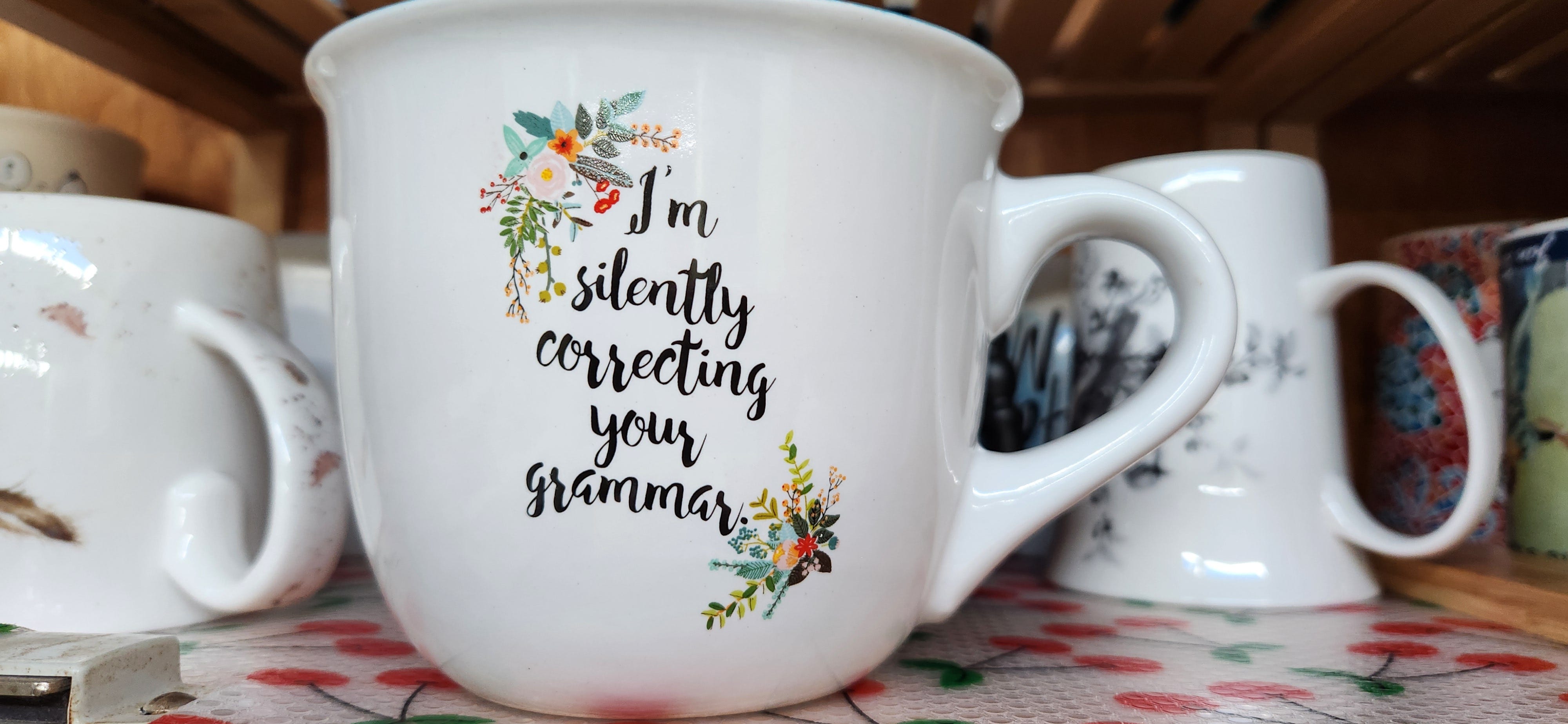
Let me preface this by saying that I believe the coffee mug you randomly pull out of the cabinet in the morning is a portent to your day.
And yes, the message on this mug is true for me. Which is why a recent debate on whether or not material created by or with the assistance of AI really makes my semantic hackles rise.
I have seen the MLA Handbook come and go. I have gone from typing handwritten notes on a typewriter to now allowing my word processing program to complete words for me automatically. It saves keystrokes – and when you have to type fast, the number of keystrokes matter. Yet, I still use double spaces at the end of sentences. I appreciate spell check. And while it annoys me at times when the word processing program attempts to correct my grammar, it’s mostly because I’ve made a deliberate word choice or phrase and it seems to think I should make it shorter and more concise.
But is this AI? If it is, then we’ve had AI for almost 20 years when Clippy was unleashed on the world. So, here’s where my opinion differs from others. Spellcheck is a tool. Word processing programs are a tool. They may correct your grammar and fix your misspellings, but it’s nothing more than a tool. Spellcheck is pattern recognition and complex Regex (a sequence of characters that defines a pattern) – and while that may sound like AI, it’s not. It was a bunch of programmers hiding in a backroom going through their experiences and asking others about what words they misspelled the most often. (For me it’s initiative and New York. For some reason I try to put an “u” in York.) This is why there are issues with their spell check programming. And why you can interchange words when they are spelled correctly and spell check will not always catch it because they’re correct
Before you had spellcheck in word processing you had to stop, flip open the dictionary and look the word up and then either use the correction tape, or hopefully, just type it. Before word processing fixed your grammar you had to grab a Harbrace College Handbook (of Grammar) and look it up. For style and formatting questions, you grabbed your MLA Handbook, Chicago Manual of Style (Turabian anyone?), or APA Handbook. (Some grammar rules were included in those, but they were mostly style guides. Or in the case of the APA provided guidelines on how to remove bias from your writing, something the original AI needed to be taught.)
Word processing simply replaced the old-school stop and look it up (or ask someone) and allowed you to get something done faster. Is this AI or is this simplification? To me it’s a tool, so that makes it simplification. While in theory it is a form of machine processing – it’s not machine learned – it was hard programmed from the old-school books and manuals. That’s what made it so hard for non-English typists – the original programming was formatted to fix only English rules and style. But not necessarily grammar (the their, there, they’re debate).
Which brings me to what started this diatribe – When do you note if something is AI-assisted or not. While one individual I know asserted that everything he does should be labeled “coffee-assisted” as his brain doesn’t function with coffee – it’s a decent point.
Here are my two cents, for what it’s worth, not withstanding the fact that my background is journalism, library science and multimedia production and design.
Is AI a tool? It could be called that – but given the fact that the point of most LLMs (aka what most people call Generative AI) is to follow a set of instructions to put together new concepts – it transcends the tool bar. Tools only “assist” and while you can use AI to help you fix your writing (grammar, style, etc) its main purpose is to create that information for you. So, this means that if you use AI to create any part of what you are passing off as your own you should note that somewhere. It could be a disclaimer at the bottom, it could be in the middle of your writing, or it could be at the top where you start off saying you had help from AI.
Just like the kid at school that brought the bathroom cold-fusion experiment for the science fair you can look at it and say “their parents probably helped.” It’s usually obvious when something has been enhanced or assisted.
People are smart and for the most part they can tell what been written by AI and what hasn’t. And yes, there are now programs to insert spelling errors, common grammatical errors and the like into AI-generated content to make it sound more human. And I recently had a disagreement with a non-native English speaker who insisted since Copilot wrote the text it was correct. No - it was wonky. We debated for 10 minutes before I just corrected it.
I am terrible at spreadsheets, pivot tables and chart creation – so I love having AI to literally just tell it to create a bubble chart using the data in A1:E26. So yes, people who know me can look at a spreadsheet and know it’s been AI assisted (that and the AI embeds a notation that it was done with AI).
I use AI to summarize large amounts of unstructured data or transcripts – but I always outright state it’s AI-generated. If I write something and I have AI assist me by doing research and writing on my behalf, I note that. But that’s my choice. I’m personally not comfortable with not telling people that AI did something. I take pride in my writing and as a result, I want people to know when I didn’t do it.
I recently took a prompt certification course, and I almost failed an assignment because the AI -grader flagged it for plagiarism. I had a direct quote from
Franklin D. Roosevelt (FDR) in a slide and gave him full credit for it. But since it matched word for word for word to what the AI could find on the internet it was flagged. Before we had AI to flag this for us, we had to guess what might have been plagiarized and look it up (first in the book or library and then on the internet). I’m sad to say that I had a vendor removed as being a trusted vendor because one of the slides I read from them sounded familiar. They had copied a statement (well, several statements) from a news article on the internet and pasted it in as their own analysis. After spending hours going through their decks – it was determined that more than 50% of what was written was provided without a citation (plagiarized) and passed off as their own.
Now, why is this important to a discussion on if it’s AI or Simplification? Because, AI – at its heart – simply reads what it can from the training material (aka Internet) and compiles it back in an order it thinks it makes sense (a very complex Regex). In reality if you don’t check your AI produced content you could be fully plagiarizing and you don’t know if you don’t check it.
Spell check and grammar check just fix what you have written – now if you’ve copied it off the internet, it won’t know, although it will correct errors if they exist. You are not violating any sort of copyright or use guidelines by using word processing or spell check tools. However, using AI is when you get into the grey area of copyright and use. And why understanding how to properly cite your content is paramount. And while Grammarly now has a built in plagiarism checker - it’s built on AI, so you’ll be relying on AI to check AI’s plagiarism.
So, a fun (well if you’re a word geek) party game is to write one word on a card or slip of paper from two standard typing sentences (search pangram) and see how many sentences a team can come up with. I played this game with Gemini and it took about seven prompts before it got it right – and the last prompt included me giving it examples of what I wanted, which it then repeated as its first answer.
When I asked Gemini to give me the total number of logical sentences that could be made from the two sentences it told me (very politely) that it could not be done. I was reminded that “grammar is flexible,” “logic is subjective,” and “combinatorics explode.”[sic] Which is quite true. (For those of you not acquainted with [sic] it means it is quoted exactly as written - which is usually bad grammar or misspellings.)
In reality I believe there will be a day when no one needs to note that AI was used to create something because it will be just as commonplace as word processing. Just as before you could tell when something had been typed and when something had been typed on a computer – for now it’s best to at least somewhere show if AI was used. It’s not a visible difference, unless you suddenly start writing in perfect Mandarin and you’ve never studied it in your life – then it’s easy to tell it was AI generated.
One parting thought – true AI-generated content that’s good enough to fool a human (or other AI) takes a vast amount of prompting – and that in and of itself takes true work and creativity. So, while I may produce AI newsletters sometimes – what you didn’t see was the 40 hours of prompt work that went into them. They’re noted as AI-generated, but only because I feel it’s (personally) morally wrong to pass off another’s work (even if it is AI) as my own.
And that is where the bottom line is – if it’s merely a tool to you then you don’t note it – and you take the risks associated with that. If you believe in giving credit where credit is due – then you do note it. Either way it’s a simplification tool.
Note: None of this was authored by AI, unless you count the brAIn.
Photo Copyright 2026 Elizabeth Roberts - stay tuned for more of my thoughts on AI and photos.
I love the simplicity and clarity of this article. It felt like a conversation with a wise friend over coffee (silly mug and all). Lots of food for thought and you showed, very politely, how much huffing and puffing (ie overcomplication) we like to add to the "writing with AI" conversation. 💫👏🏼🙏🏼
Great article Elizabeth in, for me, the most important and fundamental area regarding AI - authorship. And as in previous articles here in the 4Ds, on the Cozy Web vs the Dark Forest (where things on top are getting more and more AI generated and not authentic).
Two things I wonder though and I am a bit afraid:
1. That "disclaimers" and "notes" dont get just as a ritual and something done just to prove "transparency". If it gets like this I am afraid it will get negative consequences on its own. They should be used, but when really is the case, in my view.
2. What about if you send a text to a friend for a second opinion and review. And after you get the feedback you change some few things in the article? Should that be in a note too? I guess your answer is "no". Of course you can always dedicate or honour someone's feedback but it is more at your own choice. They are also more common if it is for a whole book - like the preface/thank you notes in the beginning of a book. So the question is how to handle these small contribuitions you can get from AI (or a friend/colleague). And also so you dont fall in the trap of #1 of being just procedural and for the sake of "transparency"?