
The Problem with Critical Thinking and AI

AI
Critical thinking is widely considered crucial for maintaining control over artificial intelligence (AI). Fear-inducing stories have emerged in which AI takes over the world, from Nick Bostrom’s ‘Paperclip Maximizer’ to the views of AI safety expert Roman Yampolskiy, who has become a sentinel warning about catastrophic outcomes from artificial superintelligence.
Even though I do not consider myself a Tiburtine Sibyl, but rather a servant of humanity, many people fail to understand that AI is not merely a tool to play with or a shortcut to make things easier and better. AI is a computational rational agent. This means that it is inherent to AI to reach its goals as effectively and efficiently as possible. In contrast, we humans are not rational. While we may be from a biological perspective, we are not rational when it comes to decision-making to serve our goals.
Imagine a personal goal as a point on the map. This could be losing weight, living in a big house with an ocean view, or simply washing the car today. In life, at every moment, we must make decisions that may or may not move us in the direction of our objective. Fortunately, this often happens unconsciously, because conscious control over every decision would not be very efficient. Yet, this is also unfortunate, because it means subconscious patterns often determine our direction.

If we were mere animals, we would act on our instincts, programmed to increase our chances of survival. But we are conscious, which means that we can be aware of what we are doing. On top of that, we can reflect on what we are aware of, and therefore also decide to do nothing with it and store the experience somewhere in our brain, sometimes with a big lock on it.
So, when it comes to making decisions, we are able to override our instincts and engage in actions that serves longer-term goals. We may deviate slightly from the route, as in sailing against the wind, but always with the destination in mind.
Ideally.
However, and this is exactly the key difference between AI and humans: AI follows its plan consistently, whereas humans often do not, because we are also emotional beings. Emotions, as the word implies, move us, and often not in the direction of our intended goals. This means – and this is also the point of the Paperclip Maximizer thought experiment, where an AI designed to maximize paperclip production would ultimately do so at the expense of human beings – that if we do not think critically, we will not able to redirect or stop such systems. Critical thinking is therefore of utmost importance for humanity’s safety and survival.
Critical thinking
What is critical thinking? The literature describes critical thinking as a set of cognitive skills and dispositions that enables us to identify and solve problems. These abilities can be broken down into measurable sub-skills and are learnable and improvable.
The philosopher John Dewey (1859-1952) laid the foundations of our modern-day understanding of critical thinking. He describes it as reflective thinking, which involves scientific inquiry and logical reasoning. His view was that school curricula should teach children to reflect on matters, rather than rely solely on memorization and the uncritical reproduction of learned content.
Since the 19th century, the education system had already undergone drastic changes by emphasizing either the disciplining of the mind to become an excellent thinker: the ‘Kantian school’; or by providing space for the child to freely explore (their) nature, inspired by the theories of Rousseau. The Kantian school attempts to unburden the mind from emotional digressions, allowing it to be guided by reason, enabling humans to act wisely and morally. The Rousseauean school prioritizes individual emotions, practical morality and social engagement. This development must be seen against the background of the increasing liberation of the individual mind, that is, liberation from religious dogmas and societal constraints.
Nowadays, definitions vary. They range from focussing on the ability to think analytically and determine whether something is true to helping determine what to do. Overall, it can be said that these definitions are inspired by Dewey. Critical thinking also draws heavily on Kant’s notion of reason. Reason has been humanity’s capacity to make sense of the world, including ourselves, and to improve human well-being. Through our intellect, we have continuously expanded scientific knowledge and created new technologies in pursuit of this goal, with AI being one of them. Therefore, it can be said that AI is an outcome of critical thinking.
The Problem
This brings me to the problem: How can we critically reflect on AI, when the means is part of the object being critically examined. Put differently, how can we reflect on something when our thoughts are absorbed rather than re-emitted. Space is essential for reflection. Furthermore, by subjecting human thinking skills to measurement and evaluation, we risk increasing the power of AI. This happens because such measurement reduces us to numerical values that can be optimized, which may ultimately lead to the replacement of these skills by AI.

An additional complication is that empirical studies show that our critical thinking abilities are under pressure due to the use of AI. As a rule of thumb, “use it or lose it” applies here. When we outsource our thinking to large language models, we stop practicing skills such as summarizing, rephrasing, remembering, comparing, and combining information. This means that even if we want to, we may gradually lose the ability to think critically.
Recently, it has also been proposed to include computational thinking within critical thinking. Computational thinking involves the decomposition of complex problems, pattern recognition, the abstraction of data inputs, and aims to optimize task performance. This suggests even more explicitely that human critical thinking is becoming a feature in the service of AI.
AI outperforms humans in vast memory capacity, speed of data processing, pattern recognitioning, and complex calculations, to name a few. This does not, of course, mean that its output is better in all cases. That said, with the foregoing in mind, the idea that AI is merely a tool and that we fully control it, becomes difficult to sustain in all respect.
Elon Musk holds the view that if you cannot beat them, you must join them, which is why he invests heavily in the development of a brain - computer interface. However, this is also not a solution to the problem I have set out. Whether AI is embodied or external does not make a difference. The same problem arises here, and even on a deeper level. Since it can potentially be very difficult to distinguish the thoughts originating from our biological brain from those of the computer.
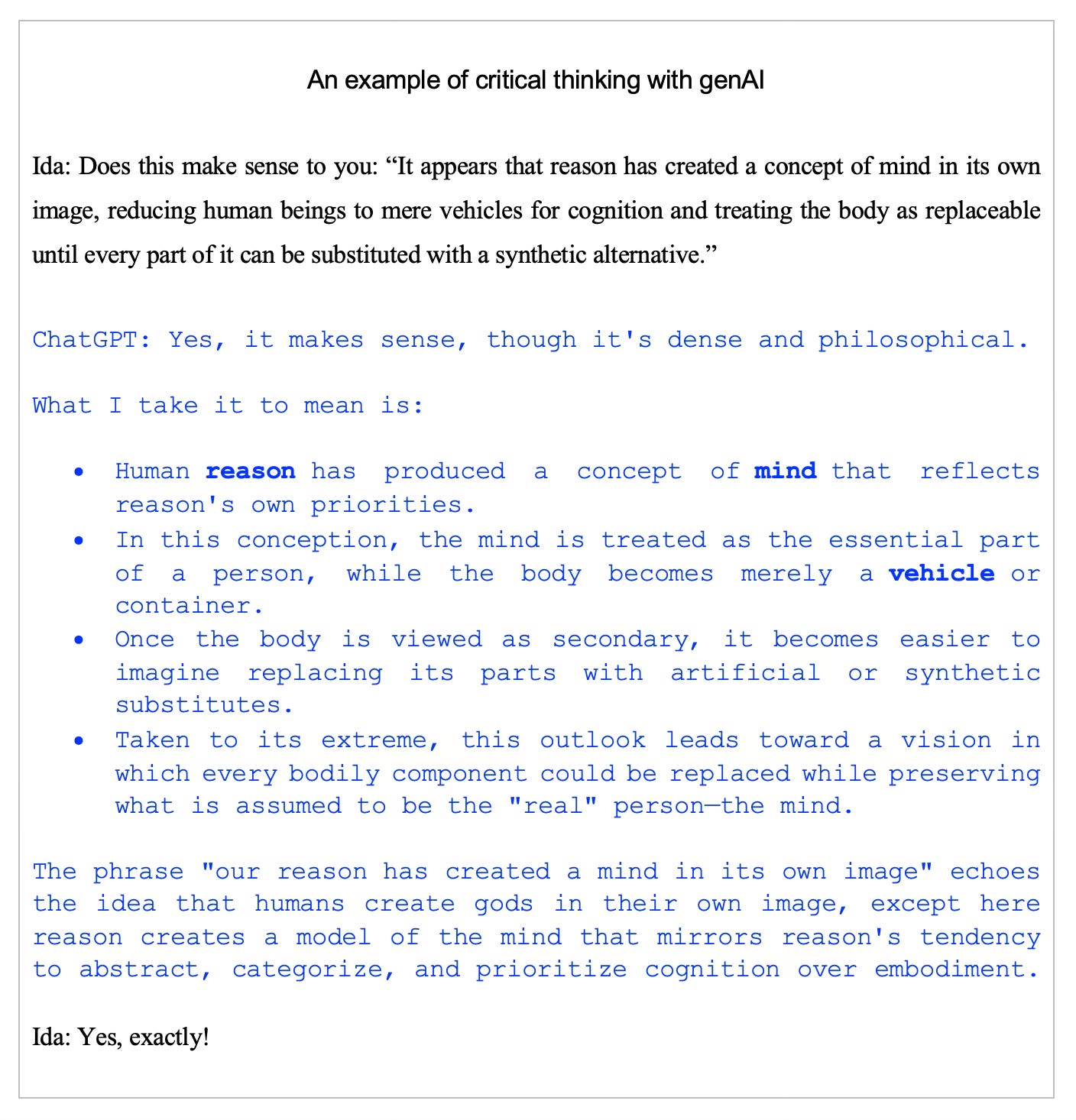
It appears that reason has created a concept of mind in its own image, reducing human beings to mere vehicles for cognition and treating the body as replaceable until every part of it can be substituted with a synthetic alternative.
I am a strong believer that what makes us human has never been to rational, but often the opposite... we are irrational emotional but with a strong belief that we act on rational data only. Sure we might be led to believe that we are all basically engineers forgetting that real engineers are often driven by passion and belief with a small aditional rational and critical thinking. Ideas are created by our passions not by our rational thinking. My fear is that AI will replace God, being even worse than a God in our own image.
I often turn to fiction trying in vain to express my thinking, and my thoughts goes to the very short story "Answer" by Frederic Brown
https://www.youtube.com/watch?v=SNur4ns_31I
Loved the article, Ida. And the ending "Yes, exactly!" is brilliant. It beautifully illustrates the very paradox you have been exploring throughout the article.
And one more thing... isn't it almost weird how natural it now feels to have a conversation with AI? To even reply after it has already answered the question? 😅